


Funded by the UK Government, the Mersey Valley Way runs 21km from the start of the River Mersey in Stockport town centre and follows the river through Heaton Mersey into south Manchester and Trafford, finishing at Ashton-on-Mersey. The route can be walked in either direction and is a mostly flat walk with few inclines.
Visit the Mersey Valley Way webpages for more information: Mersey Valley Way River Walk
Work took place in winter 2025-26 to improve physical access, waymarking and route mapping, enhance nature along the Mersey Valley and engage the public to encourage more people to enjoy this free natural resource and recreational asset.
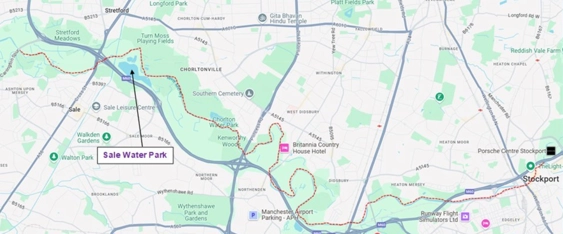
As well as the full 21km route, there are numerous shorter walks available along the route plus circular loop walks in and around the river valley. The route is well-served by public transport and the bridleway sections are easily accessible for cyclists and horse-riders, mainly following the Trans Pennine Trail.
We have also worked in partnership with Paddle UK to refresh the River Mersey Paddle Trail from Heaton Mersey to Carrington. Access agreements are already in place for paddlers to use the River Mersey along this route and several organisations along the river already provide paddle instruction, canoe and kayak hire and guided trips down the river.
A number of guided walks are being organised which will be posted on the Events page of this website and on our Eventbrite site: Eventbrite.
As part of the nature recovery work, volunteer working parties have taken place along the river valley run by City of Trees, The Conservation Volunteers, Groundwork Greater Manchester and Lancashire Wildlife Trust. Visit their websites for more information:
The Conservation Volunteers Manchester - enter your postcode to find TCV Manchester events along the Mersey in Greater Manchester
Public engagement events will take place in spring and summer 2026 to promote the river walk as well as events for local schools, youth groups and other community groups.
The Mersey Valley Walk project has been delivered by a consortium of charity and local authority partners with funding from the Department for the Environment, Food and Rural Affairs (Defra).
Share Article